
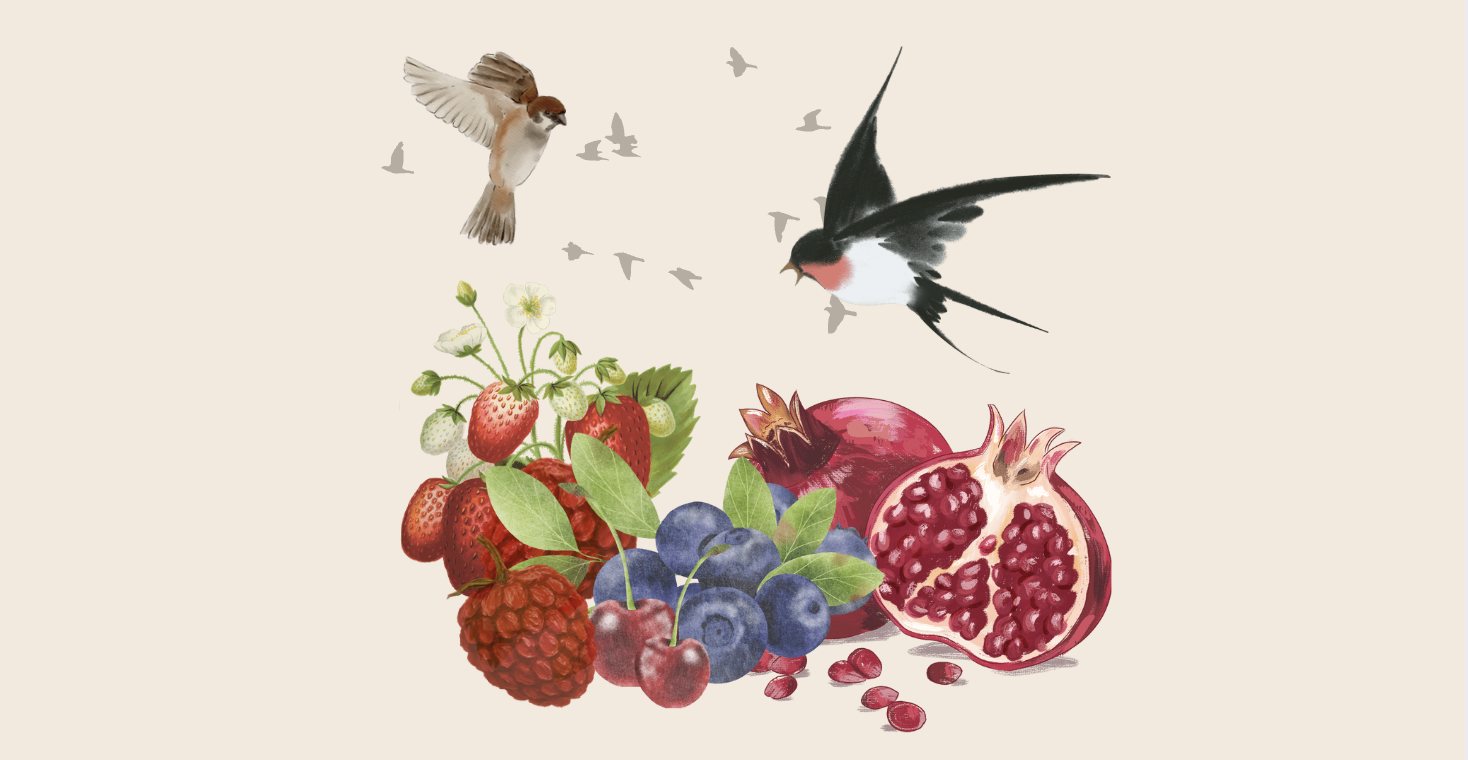
A journey into nature’s intuition
As I spent my Monday morning meal prepping for the week ahead, I tuned into Quanta podcast, this episode captivated me; In the 1960s Lynn Margulis proposed a theory that mitochondria was likely a free, independent living bacteria. This theory of endosymbiosis hints that mitochondria enveloped with our ancestral cell, birthing an integrated relationship that allowed the actualisation of multicellular creatures; whereby mitochondria have become the organelle powerhouse of every cell, creating and maintaining molecular energy through metabolic catabolism. Additionally, mitochondria contributes to cellular signaling, and has a key role in the cell cycle of differentiation, growth and apoptosis. The episode explored the scientific research that captured mitochondrial changes and adaptations for birds during migratory seasons. What captivated me is how the observed changes are attributed to seasonal cues that trigger the specific protein that governs mitochondrial growth isolating expression in the wings excluding the legs. I invite you to pause, just for a moment and [ponder/wonder] with me on the journey that life has taken. What begins at the level of a single organelle reveals patterns that echos outward through organisms, populations, and entire ecosystems; suggesting that adaptation may operate as a continuous, multi-scalar process rather than isolated biological events.
Evolution as a ecosystem
I want to begin this article, by contemplating evolution and adaptation as a winding, braided path of growth, shaped by nodes of codependent adaptation; life sustaining life. These patterns do not exist in abstraction, but are embedded in deep evolutionary time, visible in the shifting architectures of ancient ecosystems. Let’s begin by journeying back in time to the Carboniferous Period where Horsetails and Tree Ferns dominated. A world governed by the ebbs and flows between the water-locked green swamps of vegetation and the humid oxygen-rich atmosphere. Yet this system was not static; it was repeatedly disrupted and reorganised through extinction, climate shifts, and the emergence of entirely new biological strategies. 170-200 million years later, during the Cretaceous Period insects and flowers emerged, broadening the breadth of co-adaptive oscillations of the ecological pendulum. The bilateral exchange between neighbouring species enhanced the cohesive, unified survival of the other; the insects were given flowers, the flowers were a gift to the insects, these above-ground exchanges mirror deeper, less visible interactions occurring beneath the surface of the soil.
Let’s delve into the origins of exchange as we begin to examining the initial conversation between plants and the Earth. Mycelia reside in the Earth’s soil entwined and tangled around the plants intricate roots, converging the boundaries between extracellular life and the inhabited ecosystem. The complex, interwoven mycelia mushroom listen to the passing conversation of the trees, gathering up information to be exchanged at chemical junctions. Nutrients such as, water, nitrogen and carbon dioxide course through the underground network systems, attentively dispersing minerals to support the trees wellbeing. Observing these distributed networks raises a broader question about how interaction itself is structured across living systems.

Considering this pattern of distributed interaction invites a broader philosophical question, If interaction is continuous across scales, one might ask what is this fundamental unrelenting force. I found myself reflecting on panpsychism from cellular adaptation outward to system-level adaptation; the ontological pursuit of the fundamental matter of life, propelling us (life) forward into the driving force of expansion, growth and evolution. This perspective reframes biological history not as a sequence of isolated events, but as a continuous unfolding of adaptive forms expressing themselves through material existence. Actualisation has begun to take place since the first singular organism Luca, and continues today all around us. Mitosis begun, and one became two; life begun to carve its way into reality, in quite a literal sense; as the cilia evolved, so the cell could move through the sea, then fins, tails, tentacles, legs and wings were added into the pool of modalities; each allowing a new degree of exploration through the unexplored depths and terrains of land. These morphological transitions are reflected in how humans describe experience itself.
This motivation within consciousness to carve itself into existence holds its own beautiful reality; we see this around us in our language when we speak of ‘making a mark on the world’, ‘shaping the future’, ‘make an impact’, ‘leave a lasting legacy’, as we continue to strive towards imprinting our purpose into the fabric of existence. Returning to the discussion of the Earths evolution, we can stand at a birds-eye perspective, appreciating of the natural adaptations that life has taken to adapted its physical form to manoeuvre further afield, even into the unfavourable grounds that remain uninhabited by humans. The delicate dance of biochemical exchange that borders the roots with the ecosystem, to the aerial evergreen breath of the atmospheric interchange is happening all around us; codependent adaptation defines the ecosystem that we inhabit, the harmonious reciprocal movement between each force enabling symbiotic survival. At this point, it becomes useful to return to the original thread; the cellular machinery that underpins these large-scale ecological patterns.

Delicate dance in the details
So far we have discussed the symbolic ecosystem holistically. Now, let’s circle back the introductory discussion about birds and their mitochondria. During the spring nature returns with a resilient burst after the dormant winter months, plants bloom into life providing nourishing fruits, pollen and greenery all around us. The land becomes submerged in shades of bright lime, fluorescent greens and deep forest shades, erupting from each tree top to the seemingly desolate spaces between the paved brick stones. There is an abundance of food for each animal, insect and bird to satiate their hunger, metabolising enough energy to reproduce, migrate and prepare for hibernation.
Fundamentally, fruiting bodies of plants serve the purpose to be consumed, digested and carried to a new location where the seed can be disposed of. As the plants begun to expand their acquisition of land, they simultaneously supported their natural comrades. Across the natural world scientists have observed secondary metabolites in plants that offer various health benefits and nutritional supplementation. These ancillary constituents, once consumed, can afford health benefits to the animal that eat them, perpetuating survival, well in most cases at least; of course, there are many poisonous plants that animals generally have the instinct to not consume! The expulsion of excess metabolic byproducts found in the plants system, seems without consideration, coincidental; as we begin to examine berries and birds we will start grapple with at least one truth of this.
Migrating birds have more mitochondria as they increase their cellular capacity to make energy during the migratory season; oxygen production is increased across multiple species during which suggest enhanced ATP up regulation due to the activation of key enzymes. The Ruby throated Humming birds are one of the smallest species of birds and flap their wings 60x a seconds, notably, one of the animals with the highest metabolism known. Expending this much energy means that the Ruby throated humming bird has to rest regularly between feeding on nectar. However, an extraordinary transformation takes place where this tiny power-house fuelled, mitochondria pumped humming bird miraculously flies for 20 hours straight from South America across the Gulf of Mexico. Another example is the Bar-tailed godwit that can fly for up to 11 days straight without food or rest during their migration.

However, there is a deadly cost to having increased mitochondria, as the cell is working overtime it demand’s to have mechanisms in place to manage the additional waste byproducts. As the Krebs cycle burns through the resources, outputting essential fuel in the form of energy, the cell can become ‘backlogged’ with reactive oxygen species (ROS). These ROS are oxidative, when left unmanaged, an unbalanced accumulation within the body can be detrimental to health. On a cellular level, oxidation contribute to apoptosis, or in the case of migratory birds death; in the podcast, a phenomenon is described in which the flock of migrating birds are reported to suddenly fall from the sky, with no immediately identifiable cause. This is where birds become exhausted, chronically fatigued as the muscles struggle to maintain the required energy output. This creates a biological constraint: energy production must be balanced against oxidative stress.
Nature’s health advocates
Now lets take a step into into a lens scientific, as we explore the biochemical mechanisms. Anthocyanins are powerful antioxidants; as they circulate through body, they neutralise free radicals. The term anthocyanin acts as an umbrella classification, as these compounds exist with many different aglycone forms. Despite these variations, they share a common structural characteristic that contribute to their primary function. Begin to envision them as branching trees covered with antennae, attracting and binding to reactive oxygen species. These “branches” are hydroxyl (-OH) groups that are attached to an aromatic ring structure, they can donate electrons or hydrogen atoms to the ROS. Once donated, the anthocyanin molecule remains relatively stable through electron delocalisation; dispersing the reactive imbalances, the ROS become stabilised and neutralised, preventing further oxidative damage without the anthocyanin becoming highly reactive.
Researchers have long speculated how it is that migrating birds, with their relatively tiny organs are able to travel such vast distances in single flights across oceans and seemingly barren deserts. Many of these flight paths offer little to no opportunity for rest, making the journey metabolically demanding and potentially dangerous. As we have explored, mitochondria is the main facilitator of energetic capacity, and migratory routes have emerged alongside seasonal routes of juicy, bitter anthocyanin-dense berries; a natural antidote. There is a delicate choreography between the plants and the birds, each flight intersects with the fruitful availability of nutrient-rich resources supporting nutritional balance. When birds successfully reach their destinations, they are able to reproduce and complete the cycle of return migration. Evolutionary pathways have emerged throughout the preceding generations, over time these flight paths and ecological cycles display a harmonious reciprocal dance. It can be tempting to interpret this as purely chance dismissing the symbiont point of nature. When life functions on the principle of ‘survival of the fittest’, but a holistic view reveals interdependence, where the survival of one species can indirectly support the conditions for another. In this case, the berries sustain the birds ability to disperse the seeds further afield, while the fruitful harvest helps mitigate oxidative damage.
For us, oxidative damage underpins many health afflictions that we face, from cardiovascular disease and neurodegeneration to the gradual processes of ageing and systemic decline. However, oxidative damage isn’t solely attributed as marker of disease onset, but as a consequential byproduct of healthy biological functions; such as during sustained aerobic exercise and resistance training the body naturally increases mitochondrial biogenesis. Even the beneficial cellular adaptation involves a form of controlled oxidative stress that is accompanied by a rise in reactive oxygen species (ROS). In this respect we can begin to understand that health is not defined by the absence of oxidative processes, but how the body regulates and responds to them; one essential skill that birds adapted is the integration of nutrients that complement this internal balance.
Diet plays a key role in supporting the body’s regulatory systems that manages the oxidative load, with anthocyanins compounds found in red and purple fruits functioning as dietary antioxidants. Through this interaction, food becomes part of a broader adaptive network, contributing to cellular resilience and recovery. The birds’ flight paths are not separate from these ecological offerings, but intertwined through generations of evolved patterns of interaction. In this sense, birds offer a reminder that health is not isolated from the environment, but continuously shaped by it. Reflect on this ourselves: resilience is not only built through internal regulation, but through how we engage with the external systems that sustain us.

Conclusion
This ecological reciprocity invites us to reflection beyond biology, into how we interpret and interact with systems of knowledge and wellbeing in our life. The beauty of this exchange is a gentle reminder to look towards our roots, as a species and as a life-form. For this mutually beneficial exchange of coexistence guides us towards nature for inspiration, or better put, ‘back to nature’ as a reminiscent reminder of where we can find intuitive insights. As a species we are wired to connect, integrate and experience nature, in this digital age we outsource that connection through the latest trendy morning routines, tricks & hacks, we see what our celebrity icons or Instagram fitness gurus are doing to stay fit and healthy. But how often do we turn to nature to get our health advice? But really, who has the integrity and experience to give us advice? How about those little flapping warriors, that fly across literal continents, they seem pretty fit for advice!